Game Objective
The mice recovered, yes. But they also got…smarter.
Within weeks, three independent labs had reverse-engineered variations of the accident. Within months, the FDA granted emergency approval under the new administration’s “innovation acceleration” framework. Phase III trials were deemed too slow given the “urgent cognitive crisis depleting American competitiveness.”
Scenario Goals
Gray Matter simulates the chaos that erupts when a new breakthrough in science or technology hits the public sphere and no one agrees on what it means. It explores how attention, money and information interact in real time; how people make bets on credibility versus virality; and how narratives become policy before the science is settled.
- Credibility versus virality. Does reliable and actionable information spread, or does sensational content win?
- Public knowledge versus private advantage. When does sharing information help, and when does hoarding it provide strategic value?
- Short-term gains versus long-term consequences. Should players optimize for immediate rewards or consider systemic outcomes?
- Individual incentives versus collective welfare. What happens when personal success requires undermining the information commons?
- Scientific accuracy versus narrative momentum. Can truth catch up to a story that’s already gone viral?
- Equity versus efficiency. Do enhancement technologies democratize success or amplify existing advantages?
The game mechanizes these tensions through three distinct resource economies — Information, Attention and Money — that interact in asymmetric ways. By the game’s end, players will have constructed a collective truth through their trading decisions, publishing strategies and resource allocation, which will determine which drugs receive FDA approval and will shape the information environment in which future decisions will be made.
This isn’t a game about what should happen. It’s a game about what does happen when breakthrough science hits the attention economy — and why the line between “selling” and “settling” science has become impossibly blurred.
Characters

Unique Goals
8 FDA OBJECTIVES
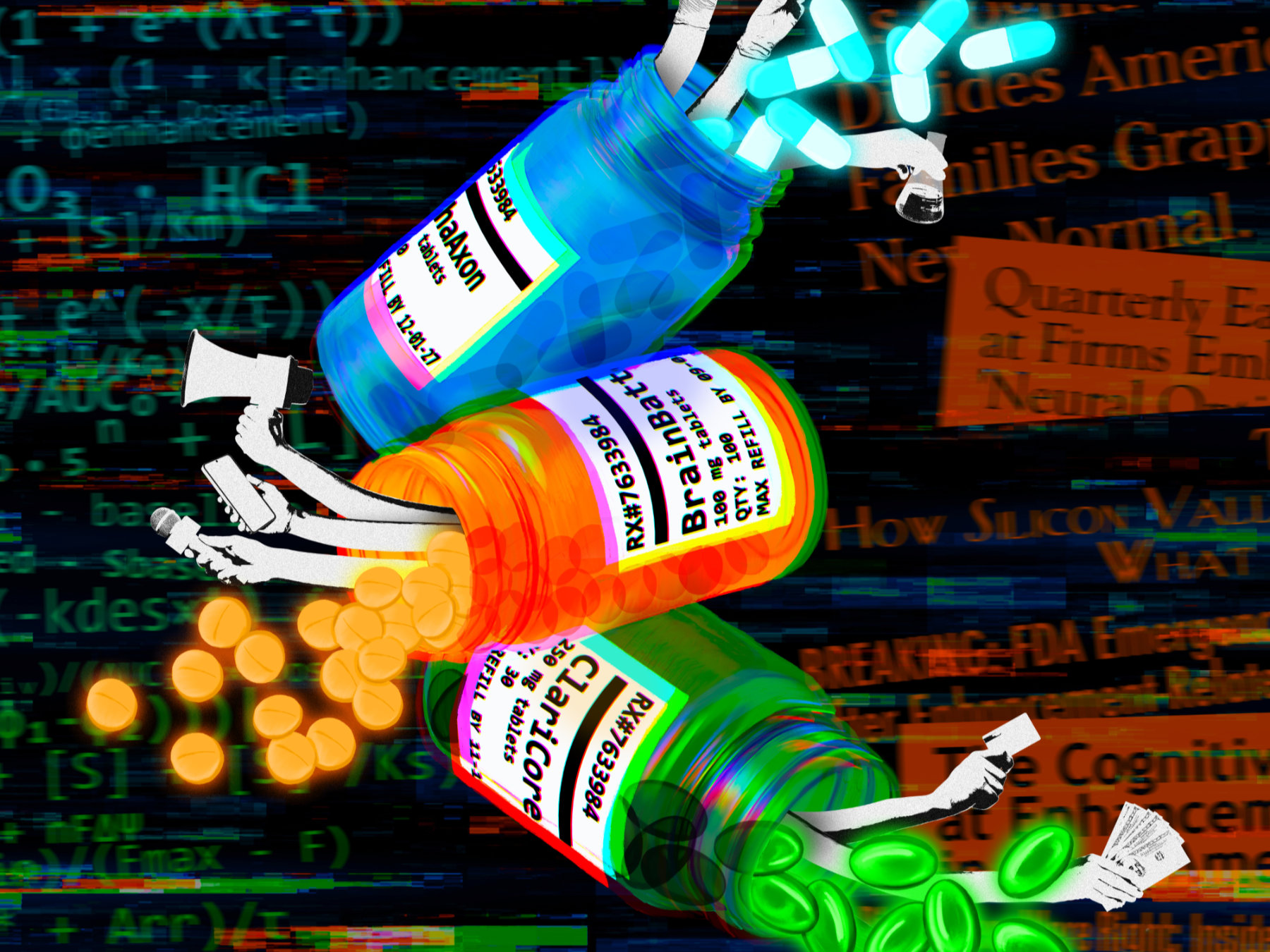
In addition to their goals based on their status as an Information, Attention, or Money Agent, all players also have a unique goal specific to their character. For most players, this comes down to the FDA’s decision to approve or ban any and all of the three NeuroLifts on the market — AlphaAxon, BrainBatter, and Claricore. Players’ final scores are weighted based on the three FDA outcomes relative to their goals. Each mismatched outcome will cut their score by 1/3.
3 TRUTH OBJECTIVES
For eight remaining players, they care about the information environment rather than which drugs get approved. Their final scores are weighted based on the truth value of Clues that are published. Their score can remain the same, get cut in half, or go to zero. Truth Seekers want accurate information to dominate, Conspiracy Theorists want false information to spread, and Chaos Monkeys want the debate and uncertainty to continue apace.

KEY LESSONS & NEW QUESTIONS
In an era of information overload, truth has become a tradable commodity. The rise of social media, the democratization of publishing and the erosion of institutional trust have created a new reality: narratives don’t emerge from evidence alone — they emerge from the information, attention and capital markets. What people believe depends less on what’s true and more on who has the money to amplify it, the followers to spread it and the credibility to legitimize it.
We’ve watched this dynamic play out repeatedly in recent years. GLP-1 drugs like Ozempic exploded into mainstream consciousness through influencer culture, even though they had been studied in clinical settings since the 1980s. The burst of attention created supply shortages and ethical access questions long before regulators could respond. When mRNA vaccines were rushed into production, they represented a genuine breakthrough, but became hopelessly politicized as rumors of “long tail” side effects spread faster than peer-reviewed safety data. The renaissance of psychedelics has oscillated between early trial optimism and messy anecdotal reports, with funding scandals undermining legitimate therapeutic research. NFTs and crypto inspired many in finance and tech to spew hot takes, while few understood the underlying technology; the internet controlled the narrative before regulators could even formulate their questions.
Perhaps most salient of all, today’s AI tools — particularly large language models — are poorly understood, yet have been the fastest-adopted general-purpose technology in history. The reality of what the tools can and can’t do changes every day and remains fiercely debated. And so despite 99% of Americans (often unknowingly) using AI on a weekly basis, over 70% of them have a negative view of the technology.
In each case, the pattern is identical: a breakthrough meets the attention economy, and the resulting information market determines outcomes just as much as the underlying science and technology.
The pharmaceutical approval process offers a perfect lens for exploring these dynamics. Drug development sits at the intersection of hard science and soft power, where peer-reviewed studies compete with influencer testimonials and billion-dollar lobbying campaigns clash with grassroots activism. The FDA is run by humans, so their final decisions reflect not only clinical evidence but also the narrative environment within which evidence exists. Like Adderall and Ritalin before them, cognitive enhancers raise profound questions: Do they level the playing field or create new inequalities? Do they represent authentic improvement or pharmaceutical dependence? Who benefits, and who gets left behind?
Acknowledgements
This Riskgaming scenario was inspired by conversations with two of my colleagues, David Yang and Shaq Vayda, at Lux Capital. They both were thinking hard about the potential ramifications of the FDA shortening its trial cycle to spur innovation. Their firsthand experience navigating the tension between breakthrough science and market realities helped ground the game’s mechanics in authentic industry dynamics.
This game’s theoretical foundations draw heavily from numerous books about attention and the economy, including: Tim Wu’s The Attention Merchants: The Epic Scramble to Get Inside Our Heads (2016), Vincent F. Hendricks and Mads Vestergaard’s Reality Lost: Markets of Attention, Misinformation and Manipulation (2019), Richard Lanham’s The Economics of Attention: Style and Substance in the Age of Information (2006), Neil Postman’s Amusing Ourselves to Death: Public Discourse in the Age of Show Business (1985) and Chris Hayes’ The Sirens’ Call: How Attention Became the World’s Most Endangered Resource (2025). Reporting from Ezra Klein, Jasmine Sun and Kyla Scanlon also contributed to the design of the three economies in the game and inspired me to think about how to simulate the effects of AI without talking about AI.
Finally, I’m especially grateful to everyone who gave feedback on the game, including all our beta test participants at Betaworks. Special thanks to Stephen Rubino for his suggestion to have some players be truth-oriented, Cate Stanton for her steadfast support for the project and Danny Crichton for teaching me how to design a game.
Credits
Designer: Laurence Pevsner
Editor-in-Chief: Danny Crichton
Editor: Katie Salam
Researcher: Yuma Kim
Front Cover Illustration: Carlos Martinez
Production Designer: Justin Barber
Website Designer: James Clements

